
  |
NOTE: This feature is available in the Professional and Enterprise versions of Stratus Desktop. |
A preproduction (or proof) order is used to record images being sent to the lab for processing and proofs being returned to your company. Preproduction orders are created from the session record.
Preproduction orders are created from an associated session. Preproduction orders can be generated automatically by Stratus Desktop or manually created by the user. See also: Managing Preproduction Orders
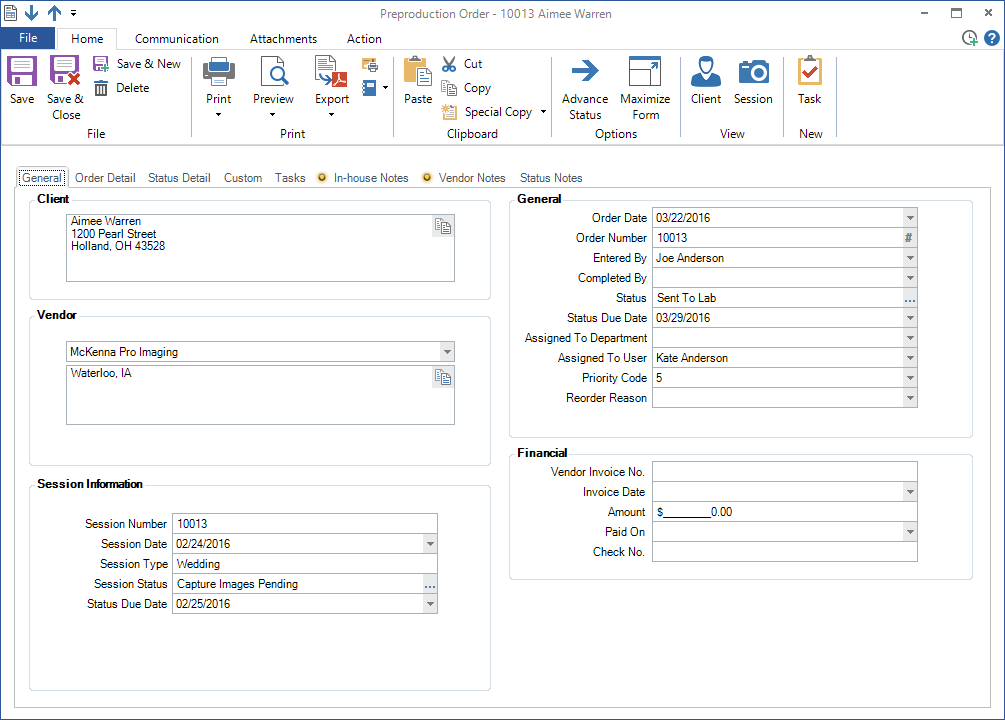
General Tab
#
| Field | Description |
| Client | (View only) Client name and address from the session. |
| Vendor | Choose the vendor from the drop-down list. Vendors are entered and maintained under Maintenance > Production > Vendors. See also: Vendors |
| – SESSION INFORMATION – | |
| Session Number | Session number the preproduction order was created from. |
| Session Date |
Date of the session. |
| Session Type | Type of session. |
| Session Status |
Current status of the session. |
| Status Due Date |
Due date of the session’s status. |
| – GENERAL INFORMATION – | |
| Order Date |
This date is automatically assigned by the software. |
| Order No. |
The software does not require this field, but having an order number makes tracking a preproduction order much easier. Click the “#” button to have the software automatically assign an order number. |
| Entered By | This field defaults to the current user, but can be changed by selecting another user from the drop-down list. |
| Completed By |
This field also defaults to the current user, but has a drop-down list to select a different user. |
| Status | Track a preproduction order by assigning a status from your preproduction status list. Click on the “…” button to the right of the line and select the proper status from the drop-down list. The software will keep track of the steps the order went through, along with the date(s) the status was changed, on the Status Notes tab. See also: Preproduction Statuses |
| Status Due Date |
The due date is calculated based on the duration you defined for the status. See also: Preproduction Statuses |
| Assigned to Department |
This is the department assigned to this status on this preproduction order. To change the assigned department, click the drop-down box. |
| Assigned to User |
This is the user assigned to this status on this preproduction order. To change the assigned user, click the drop-down box. |
| Priority Code | Assign a priority for internal information. |
| Reorder Reason | Select a reason for a reorder (from the vendor). Reorder reasons can be set up and maintained under Maintenance > Production > Reorder Reasons. See also: Reorder Reasons |
| – FINANCIAL INFORMATION – |
|
| Vendor Invoice No. | Enter the vendor’s invoice number. |
| Invoice Date | Record the date the vendor issued the invoice. |
| Amount |
Record the amount your studio was charged for this preproduction order. This amount will be used on the Profit Analysis Report if you’ve chosen to include preproduction costs. See also: Profit Analysis Report |
| Paid On |
Choose the date the invoice was paid. |
| Check No. |
Enter the check number, if applicable. |
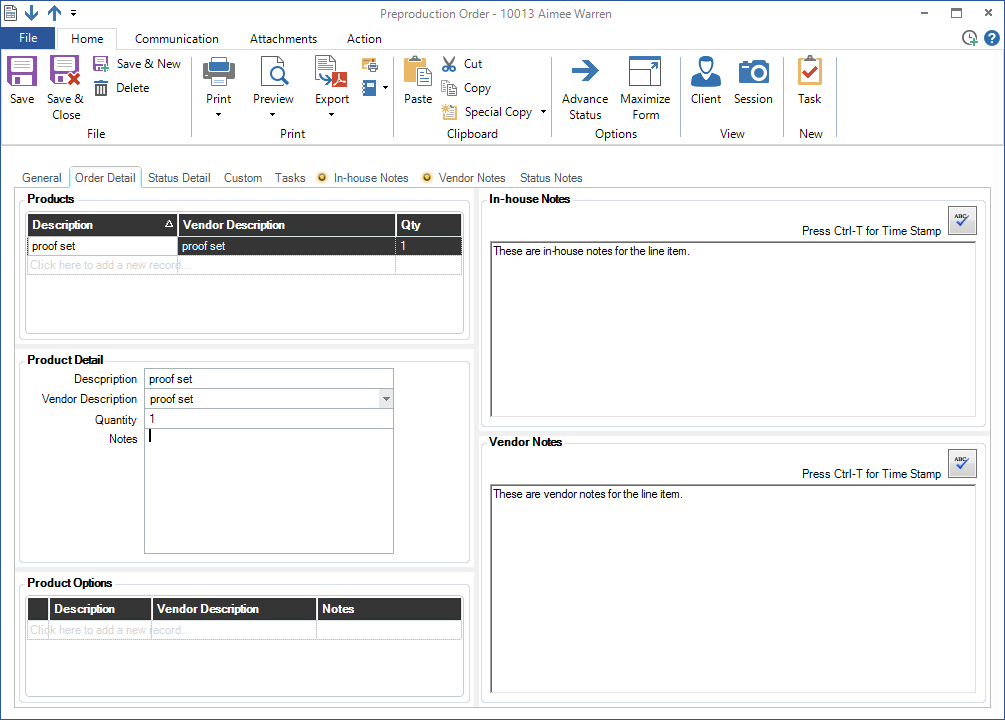
Order Detail Tab #
| Field | Description |
| – PRODUCT DETAIL – | |
| Products List |
Displays the products being ordered. Highlight a product to show the product details below. |
| Product Description | Price list description for the selected product. |
| Vendor Description | Vendor description for the selected product. |
| Quantity | Quantity ordered. |
| Notes | Notes specifically related to the selected product. |
| Product Options | List of options chosen for the selected product (i.e., matting, mounting, etc.) |
| – NOTES – |
|
| In-House Notes | Internal notes regarding the chosen product. These notes will be included on work orders. |
| Vendor Notes |
Vendor notes regarding the chosen product. These notes will be included on both purchase orders and work orders. |
Status Detail Tab #
Track the statuses of the preproduction order and see how long each status took to complete. You can also use the Start Timer to track how long it takes to complete each status.
| Column | Description |
| Status Description | Name of the preproduction status. |
| End User | User responsible for the status. |
| Start Date | Date the order entered the status. |
| End Date |
Date the order advanced to another status. |
| Days | Number of days the order spent at the status. |
| Actual Time |
Hours it took to complete the status (based on the timer). |
Custom Tab #
Use the Custom tab to track information that is not included as a preset in the software. Define the field labels in Maintenance > General (Studio) > Custom Labels. See also: Custom Labels
Tasks Tab #
Contains a list of each task related to the preproduction order.
| Column | Description |
| Urgent | This column will contain a symbol if the task has been marked as urgent. |
| Due Date |
The date the task should be completed by. |
| Task Number |
A unique number assigned by the software and used for tracking purposes. |
| Subject |
Description of the task. |
| Status |
Current status of the task. See also: Task Statuses |
| Assigned to User | The user the task is assigned to, if any. |
| Assigned to Dept. | The department the task is assigned to, if any. See also: Departments |
In-House Notes Tab #
Contains notes needed within your studio to process the order. These notes are included on work orders. See also: Printing a Work Order
Vendor Notes Tab #
Contains notes you want sent to your vendor to help them process the order. These notes are included on both purchase orders and work orders. See also: Printing a Purchase Order
Status Notes Tab #
Contains historical information about the various steps this preproduction order has gone through.